PhD Viva: 'Urban Commons: Lessons from Barcelona at the Beginning of 21st Century. A characterization proposal from the praxis'

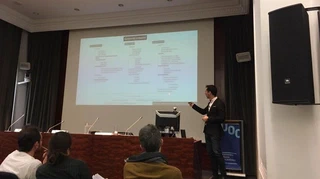
30 January 2018·
Carlos Cámara-Menoyo
· 0 min read
Photo: Ramon Ribera-Fumaz
Abstract
The concept of the commons is as strongly suggestive as ambiguous. This is evidenced by the growing interest in recent years which encompasses areas and aspirations so diverse that despite being contradictory sometimes, share a transformative vision based on cooperation. The present doctoral research focuses on one of the subgroups of such commons, that of urban commons, aiming to problematize and understand them. In order to achieve this, and after an exhaustive theoretical framework that will lead us to the roots and contradictions of the concept, we propose a situated approach based on the praxis. Based on an ethnographic study of 29 cases (8 of them analysed in depth) within the Barcelona of the beginning of the 21st century, we made 5 discursive threads about their demands, self-management and institutionalization, relationality, materiality and spatiality and technology and free culture. It is from their analysis that we obtain the keys to understand their links with the urban and the social and, ultimately, to characterize the concept of urban common in order to resolve if they can effectively be drivers of urban, social and economic transformation that lead to propose alternative and fairer cities and societies.
Date
30 January 2018 08:00 — 11:00
Event
Location

Universitat Oberta de Catalunya. Josep Laporte. Av. Tibidabo, 39. 08035 Barcelona

events
Carlos Cámara-Menoyo
Authors
Principal Research Software Engineer

I am an interdisciplinary researcher whose research articulates around how physical and digital infrastructures, especially those that are commonly produced, respond to and are shaped by societal challenges. I’ve worked as an architect, drupal developer, project manager, lecturer, data scientist, and currently as Principal Research Software Engineer.

My research interests revolve around the social aspect of technology and methods to surface the world-views that are invariably embedded in technical artefacts such as cities, software or platforms. To do so, I use mixed methods with a preference for digital methods, participatory methods and data visualisation and a keen interest in EDI and open research best practices to make research Findable, Accessible, Interoperable, and Reusable