Past, present and future of 'Zaragoza Accesible' study case

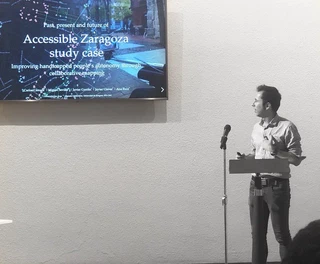 Photo: Javier Álvarez
Zaragoza
Today, cities face the greatest challenges in history due to their exponential growth, the concentration of more than half of the world’s population or the increase in wealth and social inequality, among other factors. Fortunately, it is becoming increasingly common to design, plan and manage cities taking into account aspects such as urban mobility, pollution reduction, energy efficiency, access to housing and social equality. This social awareness translates into more liveable, more efficient, fairer cities. However, this planning is usually designed on the basis of the anthropometric subject considered “normal”, paying little attention to functional diversity. Even though the number of people with some type of disability is increasing, their needs are often not taken into account, which makes it difficult or impossible for them to live autonomously and develop a full life.
Aware of this exclusion suffered by people with functional diversity, the research group OpenSource Architectures of the Universidad San Jorge organizes the first International Workshop on urban accessibility: “Inclusive Cities for All” that will take place on June 13 at the Colegio Oficial de Arquitectos de Aragón. During that day, representatives of 10 universities from 5 different countries will present their research related to the same topic: the pursue of more inclusive cities that favour the integration of people with functional diversity. Convinced that research must have some return to society if it aims to improve people’s lives, the talks will be open and free for all who want to attend.

I am an interdisciplinary researcher whose research articulates around how physical and digital infrastructures, especially those that are commonly produced, respond to and are shaped by societal challenges. I’ve worked as an architect, drupal developer, project manager, lecturer, data scientist, and currently as Principal Research Software Engineer.
My research interests revolve around the social aspect of technology and methods to surface the world-views that are invariably embedded in technical artefacts such as cities, software or platforms. To do so, I use mixed methods with a preference for digital methods, participatory methods and data visualisation and a keen interest in EDI and open research best practices to make research Findable, Accessible, Interoperable, and Reusable