Creating Interfaces tools & maps; visualization process

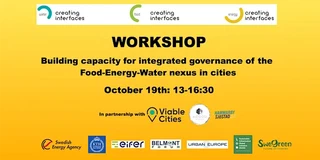 Add a caption and credit for this image.
Sweden/Online
What is the food-water-energy nexus? How could we make linkages understandable to the stakeholders including city government, academia, business community and civil society when it comes to the food-energy-water nexus?
How do we facilitate cooperation and knowledge exchange among the stakeholders? Is there any tools and methods that can complement each other for a more sustainable and resilient community and governance models?
In this workshop, the project team will present approaches, tools and visualizations developed in the project and discuss with you the replicability and usability for your local context. These are namely ‘Story Maps’ which are forms of visualization for the food-water-energy nexus in cities and our citizen science tool for data collection.
We will provide insights into experiences and lessons learned and support the exchange and networking regarding initiatives for local resilience and sustainability governance. Representatives of municipalities, private sector, academia, and local citizens are welcome to participate and share your feedback and experiences or approaches as well. We will also discuss how different tools and methods can complement each other for a more sustainable and resilient community.

I am an interdisciplinary researcher whose research articulates around how physical and digital infrastructures, especially those that are commonly produced, respond to and are shaped by societal challenges. I’ve worked as an architect, drupal developer, project manager, lecturer, data scientist, and currently as Principal Research Software Engineer.
My research interests revolve around the social aspect of technology and methods to surface the world-views that are invariably embedded in technical artefacts such as cities, software or platforms. To do so, I use mixed methods with a preference for digital methods, participatory methods and data visualisation and a keen interest in EDI and open research best practices to make research Findable, Accessible, Interoperable, and Reusable