Streetscape Perception Modelling – Theoretical Considerations and Methodological Possibilities

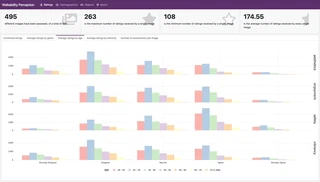 Dashboard’s screenshot
The influence of features and properties of the urban built-up environment on people’s sense of safety and perception of beauty, social vibrancy, and walkability is a topic of interest of urban geographers, designers, planners, and environmental psychologists alike. Along with emerging forms of data and the computational paradigm of Artificial Intelligence, current GIS, citizen science, and sensor technologies offer exciting technical and methodological possibilities for extracting, representing, and modelling aspects of people’s perception of streetscapes. This workshop aims to explore these possibilities, exchange research experiences, and discuss the theoretical grounds based on which we can operationalise, i.e., model, streetscape perception, particularly based on geospatial technologies.
The workshop will offer an open and interactive environment for researchers of all levels to discuss questions including, but not limited to:
- What theoretical frameworks can guide us in extracting, representing, and modelling different streetscape perception aspects of people from different social groups and cultural backgrounds?
- Which variables, parameters, and indicators these theoretical frameworks suggest and how can they be reliably extracted based on different digital technologies and participation methods?
- Which GIS interfaces, data structures, and visualisations are effective in representing people’s perception of streetscapes as to foster theory development and inform planning and policy design towards more sustainable and inclusive urban spaces?
An outcome of the workshop will be a written summary of the discussed ideas authored by all participants and published in the PLATIAL’21 proceedings. The indicative programme is as follows:
- Introduction by the organisers (20 min)
- Crash presentations by participants (optional) (20 min)
- Break-out group discussions (30 min) + World Café (30 min)
- Paper writing outlook (20 min)

I am an interdisciplinary researcher whose research articulates around how physical and digital infrastructures, especially those that are commonly produced, respond to and are shaped by societal challenges. I’ve worked as an architect, drupal developer, project manager, lecturer, data scientist, and currently as Principal Research Software Engineer.
My research interests revolve around the social aspect of technology and methods to surface the world-views that are invariably embedded in technical artefacts such as cities, software or platforms. To do so, I use mixed methods with a preference for digital methods, participatory methods and data visualisation and a keen interest in EDI and open research best practices to make research Findable, Accessible, Interoperable, and Reusable